
Precast Wall Panel Color and Finish Options Explained
11/6/2026
Most supplier pages tell you a panel's size and little else. If you are choosing a wall that will face the street or frame a garden, the colour and texture matter as much as the dimensions. This guide covers the colour and finish options for precast wall panels, how each one ages, and how to approve a finish before anything is cast.
What Sets the Look of a Precast Wall Panel
Three things decide how a precast wall panel looks: the colour of the face concrete, any surface treatment applied after casting, and the mould or liner the panel is cast against. Change one and the wall changes, even if the other two stay the same.
The wall type adds a fourth limit. Industry guidance groups precast wall systems into three basic categories: solid, sandwich and thin-shell. Each can be panelised and erected in more than one way. The type matters for finish because a deep treatment, such as heavy exposed aggregate, removes material from the face, and a thinner face layer has less to give.
So you choose the finish together with the panel, not afterwards. A finish picked from a photograph before the wall type is settled is the most common reason a specification has to be redone.
Precast panels also come in a range of sizes, shapes and thicknesses, and they often carry a decorative role as well as a practical one. That is why the finish deserves the same attention as the structure.
Coloured Precast Panels: Where the Colour Comes From
There are two ways to colour a precast panel. Pigment goes into the face concrete, or a stain, paint or sealer goes onto the surface. They age differently, and you should know which one you are buying.
Integral Colour in the Face Mix
Integral colour means pigment is mixed into the concrete that forms the visible face. The colour you see also runs through the face layer, so a chip or scratch shows the same tone underneath.
The final shade depends on three inputs: the cement, the aggregate and the pigment. Grey cement gives deeper, duller tones, while white cement lets lighter and cleaner colours come through. Pale sand or dark stone aggregate shifts the result again, especially on faces where the aggregate is exposed.
Typical palettes are greys, sands and charcoals. Earthy tones suit most South African streets and gardens because they sit well beside paving, brick and planting.
Shade varies somewhat from one cast to the next, because cement, aggregate and curing conditions are never identical twice. Agree an acceptable shade range in writing before you order, ideally with a physical sample as the reference. Without that, a "slightly different" panel becomes an argument rather than a clear reject or accept.
Surface Colour: Stains, Paints and Sealers
Surface colour is applied after casting. Stains soak into the face, paints form a film on top, and tinted sealers do a bit of both. You can use them to match an existing wall or to change a colour later.
The trade-off is durability. Sun, rain and cleaning wear surface colour away, and paint can peel or fade unevenly on a wall facing the afternoon sun. Plan on recoating from time to time, and keep a record of the product and colour used so the repair matches.
Surface colour is not a substitute for integral colour on a long-life boundary wall. It suits a smaller feature wall, or a project where you may want to change the look in a few years.
Finish Options for Precast Wall Panels
Beyond colour, the finish decides how a wall feels and how it handles dirt, light and weather. These are the wall finish options a buyer can specify. Extra finishing steps add cost, so check current walling prices in South Africa before you settle on a finish that needs several.
Exposed Aggregate, Etched and Blasted Faces
The common routes to a precast face are:
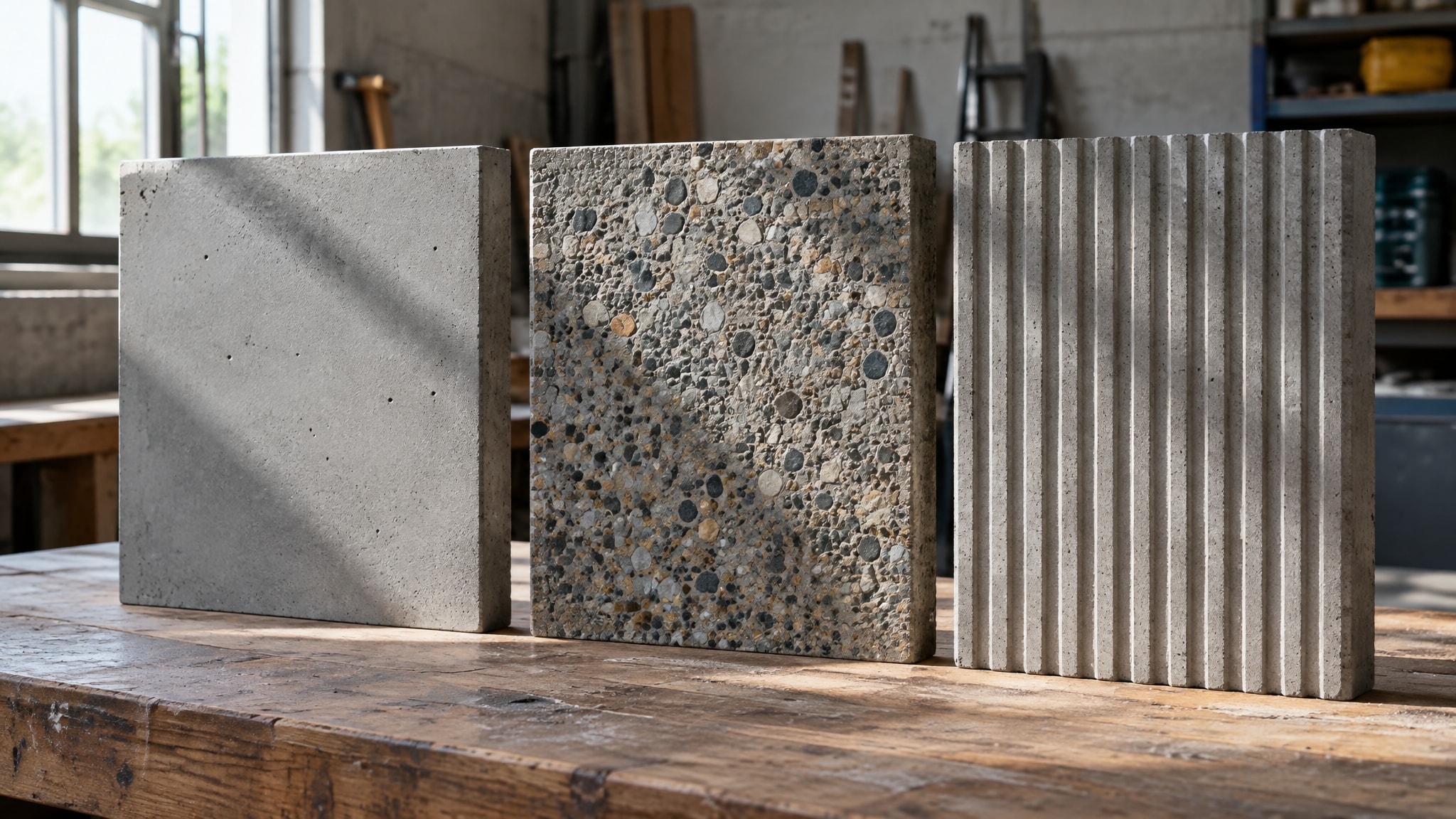
- Off-form: the mould's own finish, with no treatment after casting. It is the plainest and usually the cheapest.
- Exposed aggregate: the surface paste is removed to show the stone beneath. Colour comes mainly from the stone, so the face reads as natural and varied.
- Acid-etched: a light acid wash removes a thin skin of paste. The result is usually lighter and more uniform than exposed aggregate.
- Grit-blasted: abrasive blasting roughens the face. It sits between etched and exposed aggregate, depending on how hard it is blasted.
- Honed or polished: the face is ground smooth. It looks refined, but it is mostly an indoor or sheltered finish.
Deep exposure needs enough face thickness. A heavily exposed face on a thin-shell panel may not be possible, so check the finish against the wall type before you commit.
Textured Concrete Wall Finishes from Formliners
A formliner is a rubber or plastic sheet laid in the mould. The concrete is cast against it and takes the pattern. Common patterns include wood grain, brick, stone, geometric and honeycomb.
Formliners give you a textured concrete wall finish without any removal of the face, so they work on panels where deep exposure would not. The pattern also breaks up the light across a long wall, which helps a flat surface look less monotonous.
Be aware of the limits. A standard liner pattern is normally quick to arrange, but a custom liner adds lead time and cost. A pattern with deep relief also collects dust and water in its recesses, so it asks for more cleaning on a dusty site.
Decorative Walling in South Africa: Example Finish Choices
The same panel can look right on one site and wrong on another. These examples show how the choices work in practice. If you are still deciding on wall type and location, start with choosing walling for your property and come back here for the finish.
Boundary, Security and Estate Walls
Take a long street-facing boundary. A mid-grey exposed-aggregate face suits it well, because the grey sits comfortably beside paving and gate finishes, and the stone texture hides small marks and the slight shade differences between panels over a long run.
A security wall has different priorities. A textured face hides dust and marks better than a smooth one, and a darker tone hides them better than a pale one. The trade-off is graffiti, which is harder to clean off a deeply textured face than off a smooth one. If your street has a graffiti problem, a lighter-textured or sealed face may be the more practical choice, even though it shows dust sooner.
Estate walls usually follow a single approved look. Check the estate's design rules first, because many set the colour and texture range before you choose anything.
Feature and Garden Walls
Feature walls are where finish does the most work. Behind a pool, a honed face in a soft sand colour gives a clean backdrop that catches light well. In a garden bed, a honeycomb or stone-pattern liner adds shadow and depth against planting.
A honed face is smooth, so it shows water marks and wet-dry staining more readily. It is not the right choice for an exposed street boundary, where it will get dirty and be hard to keep looking even. Keep it for sheltered spots.
Approving a Finish Before You Order
Colour and texture look different on a screen, in a showroom and on your site. Approve the finish in the place it will be used, and get that approval on paper.
Samples, Mock-Ups and Shop Drawings
Ask any supplier for physical samples. Look at them outdoors, in both sun and shade, because the same concrete reads lighter in direct sun and flatter in shadow. Wet a sample as well, since rain darkens most faces and shows you the tone on an overcast day.
On larger jobs, ask for a mock-up panel and view it on site in daylight. A mock-up costs time, but it costs far less than replacing panels that are already installed.
Once you have approved a sample, the finish, colour and texture must go into the shop (fabrication) drawings. Those drawings are what the factory casts from, so panels only match what you signed off if the details are written there. The approved shade range from the previous section belongs on them too.
Custom liners and sample approval both add lead time before casting. If your programme is tight, raise the finish early, before the order is placed.
If you are matching paving and walling on one project, compare the slab sizes and uses alongside the wall finish, so the colours and textures work together across the whole site.
Concrete Wall Aesthetics Over Time: Weathering, Sealers and Cleaning
No finish stays exactly as it was on delivery day. Sun, rain runoff and, near the coast, salt-laden air act on the face for as long as the wall stands. Pigment and sealer choices decide how far the tone shifts, so they belong in the colour decision from the start.
Sun, Coastal Air and Cleaning
Strong sun fades surface colour faster than integral colour, and rain runoff leaves streaks below copings and gate pillars. Near the coast, salt in the air speeds up staining and can attack unprotected faces. If your site is within reach of the sea breeze, discuss the exposure before you choose a colour or a sealer.
Pale faces can show efflorescence, a white salt bloom that appears when moisture carries salts to the surface. It is usually cosmetic and often fades with time and weathering. Still, it shows most on dark and mid-tone panels, and it is something to expect, not a fault.
A sealer slows weathering, but it does not stop it. It will also need renewing, so ask which product suits your finish, and whether it changes the look. Some sealers darken the face or add a sheen.
For cleaning, test any cleaner on a small, low-visibility area first. Avoid harsh acid and abrasive cleaning on exposed-aggregate or etched faces, because both can strip the surface and leave a patch that no longer matches. Plain water and a soft brush handle most routine dirt.
Next Steps: Discussing Colour and Finish with Slabs & Walls
Slabs & Walls supplies concrete slabs, paving and walling in South Africa for construction, fencing and landscaping. To talk through colour and finish options, send the team these details:
- The project type: boundary, security, estate, feature or garden wall
- The wall length
- The site location, and which way the wall faces
- Any reference image
- The wall type, if you know it
Contact Slabs & Walls with those details and the team can advise on the finish and colour that suit your site.